Monday, August 17, 2020

10 Ways I BLEW IT as a Worship-Pastor Dad


I think have been a pretty good dad. Maybe some day I'll share a post about 10 Ways I CRUSHED IT as a Worship-Pastor Dad. But for today, I'd really like some of you who are still parenting children in your home to learn from my mistakes. My regrets. So let me steady myself for the beating you're about to give me in your mind as you read... Ok. I'm ready.
10 Ways I Blew it As a Worship Pastor-Dad (in no particular order):
  1. Self care - I regret that I didn’t take care of myself. I was morbidly obese and largely inactive. The consequences of that ranged from as minor as... not being able to ride a roller coaster with my girls to as major as... poorly modeling what it looks like to be a healthy human.
  2. Modeling time with Jesus every day - I wish y daughters would have “caught” me with my Bible open or my head bowed. I spent time with Jesus more days than not--most years. But seldom in front of them.
  3. I was afraid of my kids - this may only apply to us people pleasers, but I really struggled with push back. There were often times when I would hold back what I felt was right because I was afraid our girls wouldn't like me. Wouldn't want to be with me. For a few months, for example, I would use an EXPO marker to write verses of scripture about our identity in Christ on their bathroom mirror. They thought it was dumb. I stopped.
  4. Family devotionals / Scripture conversations and memorization - In my head this was always too grand, too complicated. In reality it could’ve been so simple. Share a thought I'd read that day in the Bible or in a book. Asking my sweet bride or our daughters what they had noticed about God that day. We could have had a memory verse for each week and repeated it when we ate together. I was overwhelmed at the the thought of doing something complicated.
  5. Praying for them daily. About their future. For theIr husbands to be. I did pray. I still do. I wish I’d prayed more and more specifically.
  6. Too much surviving the moments; not enough thinking long term. - This may be a byproduct of aging, but when I was younger, which means when our girls were little, I often just wanted to get through the day, the project, the event, or the weekend. I wish I knew then what I’ve learned in the last few years from Orange. We get 936 weeks. That’s it. Big picture first.
  7. Money management - I said yes way too often, but more than that, I said yes without consulting the Father. I wish we'd prayed about our finances, prayerfully prepared a budget. And I wish we'd included our daughters in those conversations early on.
  8. Loving their mom insufficiently - This deserves to be a book instead of a tiny chunk of a blog. I so wish I’d loved Jackie better. Moment by moment. Hour by hour. Week by week. Season by season. Year by year. In big ways, and in small ways. In faithfulness with my eyes. If I loved Jackie in the first 8 years of their lives as much—as well as—I have the last 8 years of our lives, I’d have been a better dad. The best thing a parent can do for their child, at least when it comes to teaching them about relationships, is to love their spouse well.
  9. Talked about church more than Jesus - this sort of makes sense. I work at a church. Jesus does stuff at church. But I wish I’d done better at making our lives more about Jesus and keeping the distinction clear between the Bride and the Bridegroom.
  10. Going to bed late and sleeping late - this is where it all could have started. I wish I’d started going to bed EVEN WHEN I WAS A CERTIFIED NIGHT OWL—at 9.30 and getting up at 5.30. The time I’ve had by myself in the early morning in recent months has been amazing. So much of what I already talked about might have been different if I’d been the first one up by an hour every day.
So that's my top 10. (There are more, but I can only take so much of a beating!) I'm curious, is there one you'd share too? Let's help young parents to better than we did!

Monday, August 10, 2020

Pace of Change in Church

I like to go fast.

I like to drive fast, think fast, eat fast, and lead fast. 

If I have what I sense is a God-sourced dream, I want it to come true now--if not sooner.

Churches move sssssllllllloooooowwwwww...

They like to drive cautiously, think thoroughly, extend the feast, and follow slowly.

If they hear a God-sourced dream, they want to savor it and work out all the kinks before diving in.

See a challenge here?

Maybe you're like me. Or maybe you are in a church with someone like me in leadership. 

I'm sorry.

Here's a phrase that I've found helpful in recent years, as I've tried to slow my leadership roll:

Change at the pace of pastoral care.

For example, there's an older couple in our church. I doubt seriously they'll ever read this post, but if they do--great! I didn't really know them at all. I'd been in this ministry role for about 3 years. She was having surgery. It was my turn to go to the hospital. We spent nearly a half-day together, the three of us. I heard their love story. I heard about their health struggles. I met two of their adult children. We laughed. We cried. We prayed. We hugged. It was a better-than-average hospital visit; we connected.

The next time I mentioned a need we had in the church, for something un-budgeted, they were very supportive. 

Change at the pace of pastoral care.

Now, let's check our motives here. I did not go see these folks in the hospital so they would vote for a need in my ministry. That's manipulative. In fact, I'd say it's downright gross. And they didn't support me because they were indebted to me for simply doing my job. That's scorekeeping, something 1 Corinthians 13 says love doesn't do.

I extended pastoral care. They received it. There was a connection at the heart level, experientially. It's simply what is supposed to happen when we pastor people well. 

And the more our hearts are knit together in this way, the more I want to slow down--because my heart is for them. And the more they want to help out--because their heart is for me.

And so if you are struggling with the pace of change in your ministry, maybe the key is to focus on pastoral care instead of change. Find yourself face to face in spiritual care so you can be shoulder to shoulder in spiritual work.

I am so grateful for the ways my pastor, Tim Harris, has taught me this. I sure wish I had been able to learn it 30 years ago!

Monday, August 3, 2020

Is Intimacy a Dirty Word?

I wouldn't call "intimacy" a dirty word, but I'd call it dangerous.

Still we need it.

I maintain there are (at least) 3 different kinds of intimacy, and keeping the borders strong between them can revolutionize your church-life: physical, emotional, and spiritual.

First, there's physical intimacy. This is reserved for romantic relationships. It is in degree, of course, from the brush of a shoulder to the marriage bed. When you're single, dating, exploring... you should experience some--but not all--physical intimacy. When you're married, still dating your spouse, and still exploring that one relationship... you should experience all physical intimacy. Keep the boundary strong between single and married rock solid. And if you're single, keep the boundary for yourself and your future spouse. (Hebrews 13:4)

Second, there's emotional intimacy. This exists at some level in all relationships, of course. This is a "feelings only" sort of intimacy. Those feelings can be platonic, like between siblings or parents and children. It can also be blazing fire, like between newlyweds or fighting friends. (Fighting is one of the most intimate things we do.) Emotional intimacy is powerful and, yes, dangerous. If you're married, keep emotional intimacy in check between you and anyone and everyone of the opposite sex. This doesn't mean you can't feel for someone, it just means that those feelings must continue to be defined by the relationship. You and I have feelings of compassion and care for friends who are women. But the boundary must be strong to keep the feelings there. When we sense that those feelings may be trying to test the boundaries... that's a red flag, waving strong. We have to be careful. Stir our affections for our wives again. Recognize that the spiritual attack of the enemy is involved. God has made a way out (1 Corinthians 10:13), and we MUST find it. 

Third, there's spiritual intimacy. Sometimes this one feels like emotional intimacy. But never must it cross into physical intimacy. Spiritual intimacy is the only one of these three that can be shared between members of the same sex. In fact, it's often better that way! If I cultivate a spiritual friendship with another guy, like my friend Tog Goodson for example, it is easier to disclose battles, sins, victories, and discoveries without risking an emotional affair, or obviously, a physical one.

All three require vulnerability. And the vulnerability you demonstrate must be appropriate to the definition of the relationship. Be vulnerable with your friends... your fellow believers. But beware of how vulnerable you are with members of the opposite sex. It's a minefield. The mines are real. They can blow your life up. Your enemy hopes they will.

Here's the giant challenge: every time we avoid intimacy we invite distance. And so our spiritual connections remain minimal, which stunts our spiritual growth. The testimony of scripture, especially the New Testament, is overwhelming. We grow up into Christ better together. We wither spiritually when we are alone. (Hebrew 10:24-25) And loneliness is one of the greatest epidemics of our day. 

And here's the giant hope. When God was far away, He came near in the person of Jesus Christ. And that Christ lives in you! (Colossians 1:27) There is hope. The one who demonstrated intimacy in astounding ways--in clear boundaries and self-giving love--is living Christ's life through you. You can trust others like Jesus trusted Peter, James, and John. And if you are betrayed by someone you trust, Jesus knows how that feels too. Judas was, after all, one of his twelve closest friends.

My encouragement to you today is two-fold. First, clarify and strengthen your boundaries. Second, pursue the right kind of intimacy within the right kind of relationships. You will be more like Jesus when you do. And your life will have a Jesus-shaped impact.

Intimacy isn't a dirty word at all. It's one of the most beautiful in the world!

Monday, July 27, 2020

Call a meeting with 25 year-old me!

I'm seeing more and more people writing/talking about this sort of thing. Now that I'm about to be 55 (WHAT!?!) years old, what would I go back and tell 25 year old me?

So, so much.

But where it concerns worship and Christian living, I think these seven would top the list:

1) Find a mentor. No.. find 6 mentors. And do it now. Meet with them every month or two. Walk into those conversations prepared, with a list of at least 3-5 open-ended questions. Also have handy any frustrations, tensions, or struggles you're having. And then ask your questions. Use as few words as possible. And then listen. Take notes. These guys don't have to be spiritual giants, but they do need to be ahead of you on the journey. Every year, compile your notes and review them annually. By the time you've done this 25 times you will have a PhD in practical living and ministry! (And potentially one whale of a book project.)

2) Get a journaling Bible and write in it. Daily. Don't just read the Bible, interact with it. Imagine yourself in the stories... in God's story. If it is a parable, identify which character you are. Write until the journaling space is full and then get another Bible and do it again. Your goal is not to get into the Bible, but to get the Bible into you. 

3) Shape your ministry by helping everyone else fulfill their God-dreams. If someone dreams of being a great worship leader, do all you can to help. If they want to be a Hollywood film-maker, give them lots of opportunities to make films for the church. If they "only" want to be a faithful choir member, that's okay. Don't make others into your image, help them live into the image of Christ on them.

4) Lead from a place of love and acceptance, not for the love and acceptance of others. (Thanks, Louie Giglio!) Seriously. If you aren't feeling loved and accepted, spend more time with God. If you have a sense of being 100% loved and accepted by your Heavenly Father, you will crave SO MUCH LESS the affirmation of those around you. Invite someone else into this tension so they can help you monitor it.

5) Make friends. Leadership is lonely, and perhaps leadership in the church is loneliest of all. Don't feel sorry for yourself about that, just find a way to make friends. Other guys are looking for friends too, but they're too afraid, too busy, or too distracted to go first. So ask a guy around your age to grab lunch. If it's easy to talk with them, do it again. And again. You will need people you can talk with about stuff at home and at church who don't have a "dog in that fight."

6) Love your wife more than anything or anyone except God. There's no Christmas pageant, Easter musical, Night of Worship, or choir retreat that's worth putting her aside. After salvation, she is God's greatest gift to you. Treat her like a Princess of the Most High God. Because she is. And when you do, your prayer life will be so much more powerful! (1 Peter 3:7) 

7) Oh yeah... your prayer life. It is your fuel line. If the tank is full and the engine is powerful, that's great. It's also useless unless gasoline can get to the engine. Pray like your marriage, your ministry, and your life depend on it. Because they do.

Gosh, y'all. I really want to go find the me of 30 years ago and give him this letter. What would you tell him? Better yet, what would you tell your young self?

Monday, July 20, 2020

Worship Learnings from East Africa

About this time 11 years ago I was returning from a trip to Tanzania. If you're like me, that isn't very easy to place on a map. Tanzania is a very large swath of land situated on the eastern coast of Africa, south of Kenya and north of Mozambique.

Swahili was the common language, though many people were multi-lingual. (Yes, multi. Swahili, English, French, and often a tribal dialect as well!)

The capital city, Dar es Salaam, was a study in third-world economic diversity. The vast majority were poorer than anything I'd ever seen. Cardboard huts so close together that a car--which no one could afford--wouldn't have fit down the "street." The smells were rancid. I think I described it to my sweet wife as a combination of burning trash and human waste. Yet not far away were neighborhoods with homes as nice as many in the nicer neighborhoods of my town, Bowling Green, Kentucky. Even the smell was faint there.

I traveled with my buddy, Steve Gray. We were both worship pastors, but were going to offer training to pastors. It was an amazing trip. ("Amazing" was the favorite word of our fantastic host, Moses Mboya.)

I saw beauty I'd never imagined, especially in creation and in the faces of children. I also sensed the presence and work of the Holy Spirit in ways I didn't know were possible. I am so grateful for my time there!

There were some uniqueness about the worship of locals that I found interesting enough to think you might enjoy them too. Here are my top 5:

5) Women were usually the ones "running the show." Don't let that language get in the way. While these women were definitely running things, they did more than emcee. They were spiritual authorities, and they wore that responsibility with grace and confidence. Reminds me of Jesus, who came "full of grace and truth." (John 1:14)

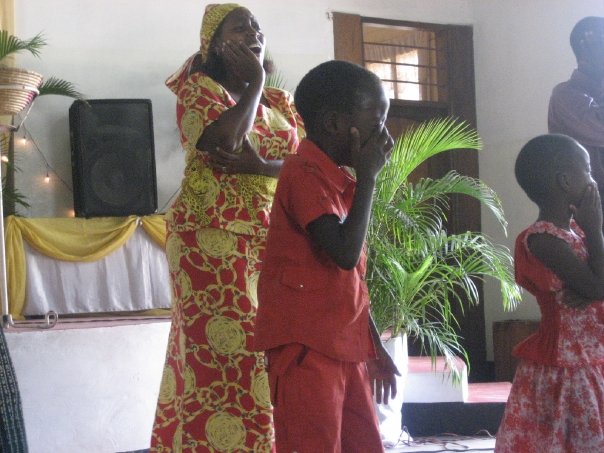
4) Children were very active in the services. They sang. They danced. They acted out Bible stories. They were always thoroughly prepared and fully engaged. Below is a picture of a little girl (maybe 8?) who was weeping as part of her character in the play-song being brought to life for us. Her tears flowed generously. There was nothing merely "cute" about the role of these youngsters. They were empowered storytellers.


3) The simple buildings were adorned with beauty. Again, even in this third-world culture, the church found ways to make the worship space beautiful. Vibrant. Sacred.

2) Singing was vigorous. I can't find a better word. They sang hard. They worshiped hard. Whether it was "How Great Thou Art" (maybe Swahili was the original language for that song... not really, but they sang it like it was!) or a song I couldn't understand and had never heard--more tribal and drum-accompanied--their singing was not obligatory or contrived. It was gut deep. Soul deep.

1) Note taking was very different. In the U.S. we tend to jot down an insightful, pithy comment the preacher makes. In Tanzania, the only thing they wrote down was scripture. It's like they were listening to us ramble until we said something God said; that's what they'd want to remember. Seems wise.

I'm concerned that U.S. culture has made much of what I described nearly impossible. So now I'm curious, what do you wish we would learn from the believers in other countries, anything?

I miss the friends I made in those 16 days. Even more, I miss the freedom the Holy Spirit had to move, to act, and to lead. Maranatha.

Monday, July 13, 2020

Unrepentant Sin

Sin is a tricky subject for any believer.

Don't agree? Then you read 1 John 3 and tell me how it works.

Just 2 verses are enough to make any of us with hair left pull it out!

"But when people keep on sinning, it shows that they belong to the devil..."

Wait. What? Yep. That's verse 8.

I wish verse 9 helped, but it doesn't: "Those who have been born into god's family... can't keep on sinning, because they are children of God."

For the worship leader, these implications are magnified. And I'm not sure about your church, but everyone on our platform keeps on sinning. Perhaps me most of all.

So how do we lead worship for the Bride of Christ in the presence of a holy God?

I can only come up with one answer.

Repent into the righteous covering of Christ.

[Repentance is more than sorrow, not less. More than confession, not less. Repentance is to change the way we think so we change the way we behave. This only happens by the kindness of our loving-Father.]

When someone comes and says, "Why are you letting so-and-so be part of the team?" (which is a valid, even if judgy question) I respond with, I'm just glad I get to be part of the team.

None of us is worthy. Not one.

But God.

Yes, but God! In His outrageously generous grace, God covers us with the righteousness (right-ness) of Christ. Hallelujah!

"For God made Christ, who never sinned, to be the offering for our sin, so that we could be made right with God through Christ." (2 Col 5:21)

But we.

Yes, but we. There is still a responsibility we have. It is simple. It is hard. It is private. It is sensitive.

We repent. Not just the first time, when we become followers of Jesus and are covered with his righteousness. (HALLELUJAH!) But we continually repent.

We become aware of our sin. We confess it to God. We confess it to someone else, perhaps our worship pastor, or pastor, or counselor, or the person we wronged. And then we ask God to help us change the way we think so we can change the way we behave.

And so when the person pushes back to my initial response above, I share the phrase that has helped me navigate this phrase: "The only thing that disqualifies us (yes, me too) from serving in worship is unrepentant sin."

Indeed, I think this is what John the Beloved was writing about in 1 John 3. Repentant sinners crave holiness. Unrepentant ones crave their own way.

So how about you? How do you handle this? And do you have words of correction or clarification for me? I'd be delighted to read them in the comments!

Monday, July 6, 2020

Relational Rehearsing and M*A*S*H?

I was talking with a good friend this morning, a young worship leader. I told him about leaving my first full-time church job--being asked to leave, that is--because I was stream rolling people rather than listening and valuing.

While I still see the young Rod poke out on occasion even now, my general disposition in ministry has changed dramatically. (So yes, there's hope!)

One of the ways I've learned to lead more relationally is specifically connected to rehearsals. Here are three that have been very helpful:

1) Invite suggestions. Rather than walking in with a fixed vision for a song, a service, or a ministry, I try to start with a really good idea and then hold it loosely. When someone says, "what if we all sing there?" or "what if the drums wait and come in here?" and I listen, perhaps try it, and then--if it is mostly as good as what I envisioned in my head--I choose their idea... well you know already, don't you? They feel heard, valued, and appreciated. You would too. I do too!

2) Say things the way they hear them. I've had to learn to be multi-lingual. Not so much Spanish, or French, or Swahili. But I try to speak in the language each person in the room can resonate with. For the music readers: measure numbers and other markings in the music. For by ear musicians: 2nd chorus or turnaround or bridge. For choir members who don't read music: I use word pictures. For the analytic among us, I use numbers (10% louder) etc.

2a) Say things the way they say things. I sometimes talk like I'm from the city... maybe a university town. I don't try to; it just comes out. But I need to learn to speak the language of the people I serve in more rural setting. So I try to listen to their words. Their phrases. The way they express themselves is the way they can best hear. So I try to sound like the best version of themselves when I talk. I wouldn't say I'm great at this, by the way. But the longer I try, the better I get. It's sort of the difference, for those of you M*A*S*H fans, between Hawkeye and Winchester.

3) Balance clear direction with flexible responsiveness. We walk into rehearsals with a thoughtful, clear plan. I use song maps for the worship songs. I put a rehearsal schedule on the whiteboard for the choir. There is clear structure and direction. But seldom does the rehearsal end with the vision unaffected. I suppose you could say we structure the flow, spur on the flow, and go with the flow.

And the flow is the people, not the music. That's what makes the rehearsal, well, relational.

I'd love to hear from you! How do you enhance relationships in rehearsals?